Difference between revisions of "Sermon for March 15th, 2026"
| (9 intermediate revisions by the same user not shown) | |||
| Line 1: | Line 1: | ||
==Job 41:1-34 (INL)== | ==Job 41:1-34 (INL)== | ||
| − | + | 1 So you'll drag out the sea-dragon, Leviathan — with hook and line you'll sink him? | |
| − | + | 2 So you'll poke a twig through his terrible nose, pierce his cheek with a thorn? | |
| − | + | 3 So he'll plead with you in soft-spoken words? 4You'll cut him a deal as your slave? | |
| − | + | 5 You'll sport with him like a sparrow; leash him up for little girls? | |
| − | + | 6 Let tradesmen haggle over his hide, while merchants take their share? | |
| − | + | 7 Or riddle that hide with harpoon holes, his head with fishing spears? | |
| − | + | 8 You'll place your hand upon him, then? Think of that battle — better think again! | |
| − | + | 9 What! All expectations of him fail; one falls at the eye-sight of him. | |
| − | + | 10 A cruel one, indeed, I roused him up. Who cares to contend with me? | |
| − | + | 11 To whom am I indebted now? All under heaven is mine. | |
| − | + | 12 I'll not silence his bellow, nor boasts of his deeds, nor the dignity of his design. | |
| − | + | 13 Who could remove his outermost robe, or break through his battle dress? | |
| − | + | 14 Who loosed the gates of his grinning face — fearful fangs far and wide? | |
| − | + | 15 Shield-ranks seal the skin of his back; 16one by one, they are woven air-tight. | |
| − | + | 17 Each to another they clasp and cleave and cannot be cut apart. | |
| − | + | 18 He sneezes and light bursts brightly forth; He blinks as the break of dawn. | |
| − | + | 19 Fire from his face-cavern and sparks fly forth; 20smoke from his seething snout, | |
| − | + | 21 His billowing breath kindles hot coals; a blaze comes forth from his maw. | |
| − | + | 22 Brute force abides in the strength of his neck, but nimbly bounds before. | |
| − | + | 23 The flakes of his flesh together cleave—cast firmly, they cannot be moved. | |
| − | + | 24 His breast-cage is clad in solid rock, set in stone from far below. | |
| − | + | 25 At his rising the angels fear; they falter at his crash. | |
| − | + | 26 He who finds him fails with blade—or bolt or pike or flying spear. | |
| − | + | 27 He reckons hard-wrought iron as straw, bronze as rotten wood. | |
| − | + | 28 No arrow's offspring makes him run; rocks from slings are reduced to rubble. | |
| − | + | 29 Bludgeons counted like blades of grass, he grimly laughs at shaken spears; | |
| − | + | 30 Jagged shards his belly gird; with barbed broom he sweeps the mud. | |
| − | + | 31 The deep he brings to cauldron-boil, like chemist's brew he stirs the sea; | |
| − | + | 32 A highway shines in his watery wake; a white-haired wave it seems | |
| − | + | ||
| − | + | ||
| − | == | + | 33 He is unrivaled on the earth — without any fear is he formed. |
| + | 34 He beholds all those who are lofty-born; of the proud he alone is Lord. | ||
| + | |||
| + | ==The Monsters at the End of the Book - Part II== | ||
A monster walked into a bar one day. When the bartender looked up and saw a monster standing there, he said "Hey, did you know there's an energy drink named after you?" The monster got really excited, and said "You have a drink named Fred?" | A monster walked into a bar one day. When the bartender looked up and saw a monster standing there, he said "Hey, did you know there's an energy drink named after you?" The monster got really excited, and said "You have a drink named Fred?" | ||
| Line 42: | Line 43: | ||
But what are they? Where do they come from? Are they real? Imaginary? Good? Evil? Somewhere in between? What does the Bible say about monsters? And what does our fascination with monsters say about us? Last week and this week, we're talking about the two "monsters" described by God at the end of the Book of Job. Last week, we talked about the land monster, Behemoth. Today we'll talk about the sea monster, Leviathan. | But what are they? Where do they come from? Are they real? Imaginary? Good? Evil? Somewhere in between? What does the Bible say about monsters? And what does our fascination with monsters say about us? Last week and this week, we're talking about the two "monsters" described by God at the end of the Book of Job. Last week, we talked about the land monster, Behemoth. Today we'll talk about the sea monster, Leviathan. | ||
| − | + | The Hebrew word לִוְיָתָן (Livyatan)is from an even older word that means garland or wreath (think twisted coils). This is how he sometimes appears in early art ([[http://mrlocke.net/Job/Leviathan/byzantinemanuscript.jpg Rome, Biblioteca Apostolica Vaticana, Codex Gr. 749]). But unlike his counterpart, Behemoth, Leviathan shows up a few other places in scripture, too. Isaiah 27 describes the day (in the future) in which God will punish Leviathan and slay him with a sword (however, this may be a coded reference to a foreign nation that Isaiah is prophesying against) ([http://mrlocke.net/Job/Leviathan/doreleviathan.jpg Dore Illustration]). Psalm 74 describes a day (in the past) when God killed Leviathan, breaking his heads (plural) into pieces and feeding him to the people. And Psalm 104 describes Leviathan as God's creation, who frolics joyfully in the sea. | |
| − | + | There is a serpentine sea-monster in the mythology of just about every ancient culture. In Norse Mythology, it's [http://mrlocke.net/Job/Leviathan/jörmungandr.jpg Jormungandr], the serpent who rings the world, and eats his own tail. In Egyptian and Greek Mythology, it's [http://mrlocke.net/Job/Leviathan/ouroboros.jpg Ouroboros]. In Mayan mythology, it's [http://mrlocke.net/Job/Leviathan/quetzalcoatl.png Quetzalcoatl]. Notice the similarity between this and [http://mrlocke.net/Job/Leviathan/ambrosianbible.jpg last weeks image] of Behemoth, Leviathan, and Ziz from the Ambrosian Bible. | |
| − | + | There's another mythological strand that connects even more closely to the Biblical Leviathan. In Egyptian mythology, the monster [http://mrlocke.net/Job/Leviathan/apep.jpg Apep] is the embodiment of Chaos. Each day, Apep lies in wait just below the horizon and swallows the sun god, the bringer of light. Light is associated with order, and darkness with chaos. There's also a Native American legend about a [http://mrlocke.net/Job/Leviathan/nativeamericansnake.jpg snake] swallowing the sun. At some point in his development, Leviathan takes on similar characteristics. Listen to Job's words in chapter three. This is the very first of Job's speeches after he loses everything: | |
| − | + | ||
| − | + | ||
| − | + | ||
| − | + | ||
| − | There's another mythological strand that connects even more closely to the Biblical Leviathan. In Egyptian mythology, the monster [http://mrlocke.net/Job/Leviathan/apep.jpg Apep] is the embodiment of Chaos. Each day, Apep lies in wait just below the horizon and swallows the sun god, the bringer of light. Light is associated with order, and darkness with chaos. | + | |
| − | + | ||
| − | There's also a Native American legend about a [http://mrlocke.net/Job/Leviathan/nativeamericansnake.jpg snake] swallowing the sun. | + | |
| − | + | ||
| − | At some point in his development, Leviathan takes on similar characteristics. Listen to Job's words in chapter three. This is the first of Job's speeches after he loses everything: | + | |
Let the day perish in which I was born, and the night that said, A man-child is conceived. Let that day be darkness! May God above not seek it, or light shine on it. Let gloom and deep darkness claim it. Let clouds settle upon it; let the blackness of the day terrify it. That night—let thick darkness seize it! Let it not rejoice among the days of the year; let it not come into the number of the months. Yes, let that night be barren; let no joyful cry be heard in it. | Let the day perish in which I was born, and the night that said, A man-child is conceived. Let that day be darkness! May God above not seek it, or light shine on it. Let gloom and deep darkness claim it. Let clouds settle upon it; let the blackness of the day terrify it. That night—let thick darkness seize it! Let it not rejoice among the days of the year; let it not come into the number of the months. Yes, let that night be barren; let no joyful cry be heard in it. | ||
| Line 67: | Line 59: | ||
Fast forward to Anglo-Saxon England during the medieval period, where the giant fanged mouth of Leviathan, described in Job 40, gets mixed together with the Norse legend of Fenrir, also a god of Chaos who, incidentally, also swallows the sun ([http://mrlocke.net/Job/Leviathan/fenrir.jpg 1908 drawing by W.G. Collingwood]). Fenrir morphs into Leviathan to become "Hellmouth," his jaws depicted as the very gates of hell. ([http://mrlocke.net/Job/Leviathan/hellmouth.jpg Winchester Psalter of about 1150]). Images of Hellmouth become popular throughout Medieval Europe ([http://mrlocke.net/Job/Leviathan/bourgesjaws.jpg Bourges Cathedral, ca. 12th century]) and right down to our own day ([http://mrlocke.net/Job/Leviathan/sarlacc.jpg Sarlacc from Return of the Jedi]) | Fast forward to Anglo-Saxon England during the medieval period, where the giant fanged mouth of Leviathan, described in Job 40, gets mixed together with the Norse legend of Fenrir, also a god of Chaos who, incidentally, also swallows the sun ([http://mrlocke.net/Job/Leviathan/fenrir.jpg 1908 drawing by W.G. Collingwood]). Fenrir morphs into Leviathan to become "Hellmouth," his jaws depicted as the very gates of hell. ([http://mrlocke.net/Job/Leviathan/hellmouth.jpg Winchester Psalter of about 1150]). Images of Hellmouth become popular throughout Medieval Europe ([http://mrlocke.net/Job/Leviathan/bourgesjaws.jpg Bourges Cathedral, ca. 12th century]) and right down to our own day ([http://mrlocke.net/Job/Leviathan/sarlacc.jpg Sarlacc from Return of the Jedi]) | ||
| − | John Calvin and other 16th century reformers speculated that Leviathan was a whale. Herman Melville, in his classic novel Moby Dick, unsurprisingly does the same. Thomas Hobbes named his famous book about civil government "Leviathan," and the [http://mrlocke.net/Job/Leviathan/hobbes.jpg original book cover] quotes Job 41:24. Other modern interpreters (including the footnotes to the NRSV) have concluded that Leviathan must be a crocodile, generally on the basis of the verses in Job that describe the creature's scaly back. | + | John Calvin and other 16th century reformers speculated that Leviathan was a whale. Herman Melville, in his classic novel Moby Dick, unsurprisingly does the same. Thomas Hobbes named his famous book about civil government "Leviathan," and the [http://mrlocke.net/Job/Leviathan/hobbes.jpg original book cover] quotes Job 41:24. Other modern interpreters (including the footnotes to the NRSV) have concluded that Leviathan must be a crocodile, generally on the basis of the verses in Job that describe the creature's scaly back. Young earth creationists (as they do with Behemoth) point to the dinosaur. Of course, neither crocodiles, nor whales, nor dinosaurs (or any actual creature) are known to breathe fire, so all attempts to classify Leviathan are somewhat problematic. In fact, I think it's quite intentional that Leviathan defies classification. Isn't that the point of the poem--that Leviathan cannot be captured or comprehended? What is classification, if not just a 20th century way of capturing something? |
| − | + | My favorite take on Leviathan, however, comes from the Jewish Talmud (Avodah Zarah 3b), which teaches that God follows a strict daily routine: | |
| − | + | ||
| − | + | #For the first three hours of every day, God studies the Torah. | |
| + | #For the next three hours, he judges the world, and gets pretty frustrated. | ||
| + | #For the next three hours, he feeds and sustains all of creation (also hard work) | ||
| + | #So for the final three hours of each day, God plays with Leviathan in order to unwind. | ||
| − | + | I love this idea of God and Leviathan frolicking together in the sea--the Creator and his pet, both taking great joy from each other's companionship. | |
| − | + | I love this idea, because I have a dog. Her name is Genevieve Ilana Locke, and she is (in my opinion) the best dog in the world. She is a strikingly beautiful purebred Bluetick Coonhound. To me she is a source of great comfort and joy (and occasional annoyance). She's a medium sized dog--big enough to jump a fence, but small enough to pick up, or to curl up in your lap. But if you happen to be a squirrel, or a cat, or (God forbid) a raccoon... then to you she would seem like a terrible, ferocious, destructive, and even deadly monster. | |
| − | + | So she can be delightful...or she can be frightening, depending on your perspective. Both of those things can be true simultaneously, and I suspect the same is true of Leviathan. The same is true of chaos, and the powerful but destructive forces of nature--things like hurricanes, volcanoes and earthquakes (things which insurance companies used to call "Acts of God"). If you are the victim of those forces (like Job was), they are monstrosities. But in the grand scheme of God's creation, they also have a function, they serve a purpose, they are part of a rhythm, a routine, and a process by which mountains are formed, ecosystems are replenished, and energy is rebalanced for the benefit of the planet and all its inhabitants. | |
| − | + | Of course, that perspective on Leviathan, while it is my particular favorite, would not have been very comforting to Job in the aftermath of his losses. | |
| − | There is | + | |
| + | There's one more perspective on Leviathan which I think is hinted at in the Book of Job, and it connects with the perspective I shared last week on the other monster at the end of the book, Behemoth. I told you that I think Behemoth represents Job (and by extension, all of us). Behemoth is God's way of saying, look at this mighty creature--you are strong, just like him. You have what it takes to get through this. | ||
| + | |||
| + | Leviathan, in this perspective, is a bit different. Allow me to explain (but see if you can figure it out before I get to the end!). | ||
| + | |||
| + | At the very beginning of Job's long speeches that span most of the book, he demands that Leviathan be summoned. Later, he demands that God appear before him as well. At the end of the book, both God and (through his words) Leviathan show up. God's speech to Job has two movements. In the first, God speaks of creation--the earth, the sea, the snow, the rain--and then he goes on to describe several lesser animals--the lion, the mountain goat, the donkey, the ox, the ostrich, the horse, the hawk. If we were going to include whales, elephants, crocodiles and hippos, I would think this would be where they might fit best. | ||
| + | |||
| + | But in the second movement of God's speech, he describes the foremost wonder of his creation, the strong and mighty Behemoth--a mirror and symbolic representation of Job. | ||
| + | |||
| + | Then in that same section, we come to the climax, the most magnificent monster of all. All expectations of him fail; one falls at the eye-sight of him. At his rising the angels fear; they falter at his crash. He is unrivaled on the earth--without any fear is he formed. He beholds all those who are lofty-born; of the proud he alone is Lord. | ||
| + | |||
| + | Have you figured out who Leviathan is yet? One more clue. Job has asked for Leviathan to be roused, and God says, A cruel one, indeed, I roused him up. Who cares to contend with me? Note that God doesn't say, "I roused him up. who cares to contend with him?" He says, I roused him up...who cares to contend with me? If Behemoth represents Job, then I think Leviathan, here, represents God himself. Often in the Bible, God is associated with the highest heights. But occasionally it goes the other way. Romans 11:33 - O how deep are God's riches, and wisdom, and knowledge! How unfathomable are his decisions and unexplainable are his ways! Leviathan brings the deep to a cauldron boil and makes the deep look white-haired (the classic representation of God as "ancient of days"). | ||
| − | + | When Job invokes Leviathan earlier in the book, he says, "Let the stars of its dawn be dark; let it hope for light, but have none; may it not see the eyelids of the morning." God, through Leviathan, is responding directly to Job's request when he says, "He sneezes and light bursts brightly forth; He blinks as the break of dawn." In other words, "You summoned me, Job. You summoned Leviathan to snuff out your light and plunge you into darkness. But Leviathan doesn't work that way. He brings light instead. I'm bringing you back into the light." | |
| − | + | The monsters at the end of the book are the same ones each of us will encounter at the end of our own story--the ones Michelangelo so masterfully depicted on the ceiling of the Sistine chapel. One of those monsters is truly terrifying--and the other one is us. | |
| − | + | When I come home at the end of the day, Genevieve, my Bluetick Coonhound, is without fail, every single time, completely overjoyed to see me. (I realize I'm totally messing up the metaphor here, but bear with me!). | |
| − | + | Sometimes, her joy at seeing me is tempered with a little bit of well-placed fear--like when she knows that she has gotten into the kitchen trash can and spread out all of the trash across the kitchen floor. She knows there will be a reckoning--and usually she puts herself in her kennel immediately after I discover the mess. But she also knows that no matter what she's done, no matter how rough her day was, or how hard the reckoning--she knows that without fail, every single time, she will end her day curled up in my lap, drifting off to sleep, completely forgiven, completely and totally loved. | |
| − | + | That's not a bad ending for a little monster, and for the big monster who loves her. | |
| − | + | So it is with God, with those who love him, and those whom he loves. That's Leviathan. That's Job. That's me. That's you. | |
Latest revision as of 05:18, 15 March 2026
Job 41:1-34 (INL)
1 So you'll drag out the sea-dragon, Leviathan — with hook and line you'll sink him?
2 So you'll poke a twig through his terrible nose, pierce his cheek with a thorn?
3 So he'll plead with you in soft-spoken words? 4You'll cut him a deal as your slave?
5 You'll sport with him like a sparrow; leash him up for little girls?
6 Let tradesmen haggle over his hide, while merchants take their share?
7 Or riddle that hide with harpoon holes, his head with fishing spears?
8 You'll place your hand upon him, then? Think of that battle — better think again!

9 What! All expectations of him fail; one falls at the eye-sight of him.
10 A cruel one, indeed, I roused him up. Who cares to contend with me?
11 To whom am I indebted now? All under heaven is mine.
12 I'll not silence his bellow, nor boasts of his deeds, nor the dignity of his design.
13 Who could remove his outermost robe, or break through his battle dress?
14 Who loosed the gates of his grinning face — fearful fangs far and wide?

15 Shield-ranks seal the skin of his back; 16one by one, they are woven air-tight.
17 Each to another they clasp and cleave and cannot be cut apart.
18 He sneezes and light bursts brightly forth; He blinks as the break of dawn.
19 Fire from his face-cavern and sparks fly forth; 20smoke from his seething snout,
21 His billowing breath kindles hot coals; a blaze comes forth from his maw.
22 Brute force abides in the strength of his neck, but nimbly bounds before.
23 The flakes of his flesh together cleave—cast firmly, they cannot be moved.
24 His breast-cage is clad in solid rock, set in stone from far below.

25 At his rising the angels fear; they falter at his crash.
26 He who finds him fails with blade—or bolt or pike or flying spear.
27 He reckons hard-wrought iron as straw, bronze as rotten wood.
28 No arrow's offspring makes him run; rocks from slings are reduced to rubble.
29 Bludgeons counted like blades of grass, he grimly laughs at shaken spears;
30 Jagged shards his belly gird; with barbed broom he sweeps the mud.
31 The deep he brings to cauldron-boil, like chemist's brew he stirs the sea;
32 A highway shines in his watery wake; a white-haired wave it seems
33 He is unrivaled on the earth — without any fear is he formed.
34 He beholds all those who are lofty-born; of the proud he alone is Lord.
The Monsters at the End of the Book - Part II
A monster walked into a bar one day. When the bartender looked up and saw a monster standing there, he said "Hey, did you know there's an energy drink named after you?" The monster got really excited, and said "You have a drink named Fred?"
Monsters have terrified and fascinated people since the very dawn of humanity. They appear in our earliest art, literature, and mythology. They adorn the architecture of some of our most prestigious buildings, and they routinely draw larger audiences than some of our highest paid movie actors and actresses. We love monsters. We fear monsters. We love to fear monsters.
But what are they? Where do they come from? Are they real? Imaginary? Good? Evil? Somewhere in between? What does the Bible say about monsters? And what does our fascination with monsters say about us? Last week and this week, we're talking about the two "monsters" described by God at the end of the Book of Job. Last week, we talked about the land monster, Behemoth. Today we'll talk about the sea monster, Leviathan.
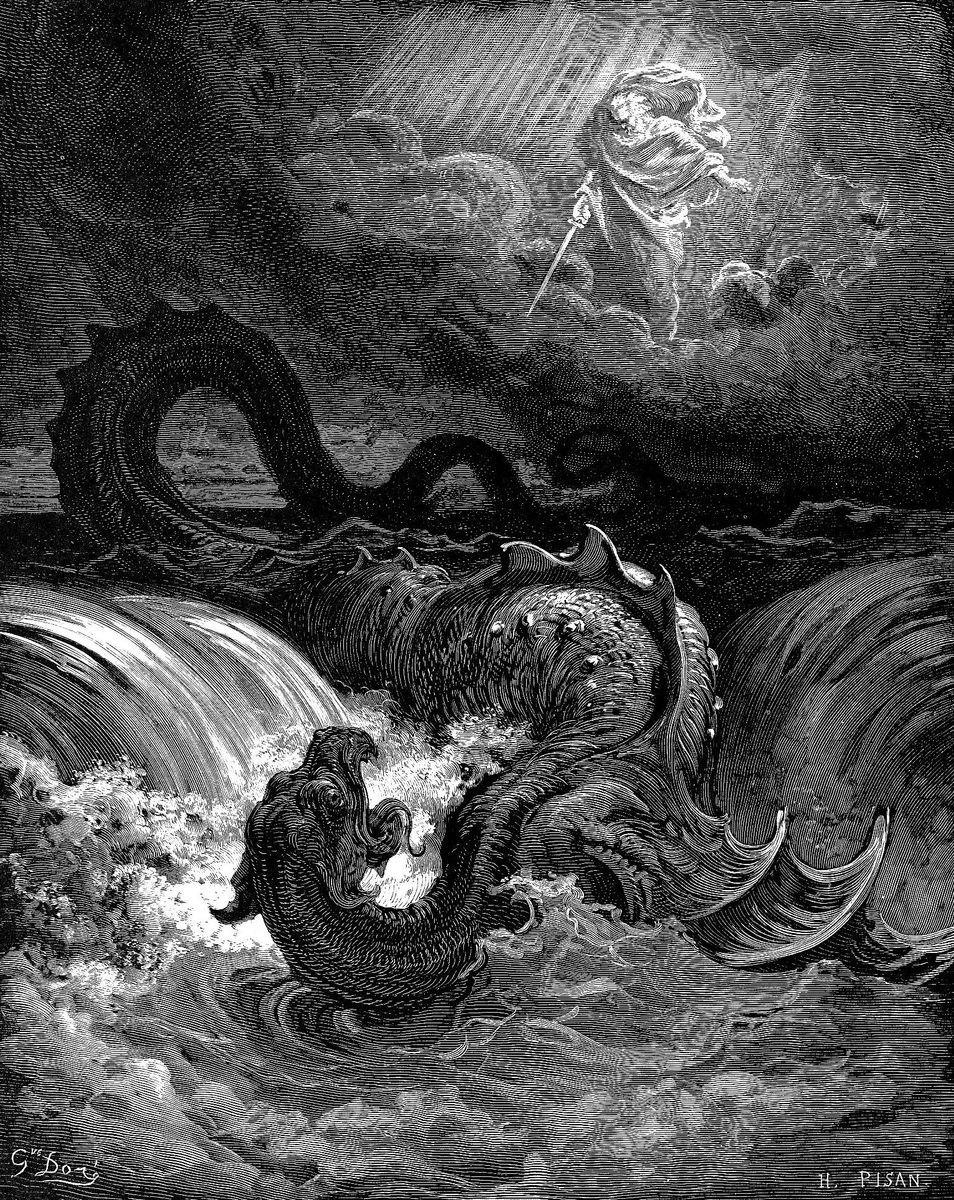
The Hebrew word לִוְיָתָן (Livyatan)is from an even older word that means garland or wreath (think twisted coils). This is how he sometimes appears in early art ([Rome, Biblioteca Apostolica Vaticana, Codex Gr. 749). But unlike his counterpart, Behemoth, Leviathan shows up a few other places in scripture, too. Isaiah 27 describes the day (in the future) in which God will punish Leviathan and slay him with a sword (however, this may be a coded reference to a foreign nation that Isaiah is prophesying against) (Dore Illustration). Psalm 74 describes a day (in the past) when God killed Leviathan, breaking his heads (plural) into pieces and feeding him to the people. And Psalm 104 describes Leviathan as God's creation, who frolics joyfully in the sea.
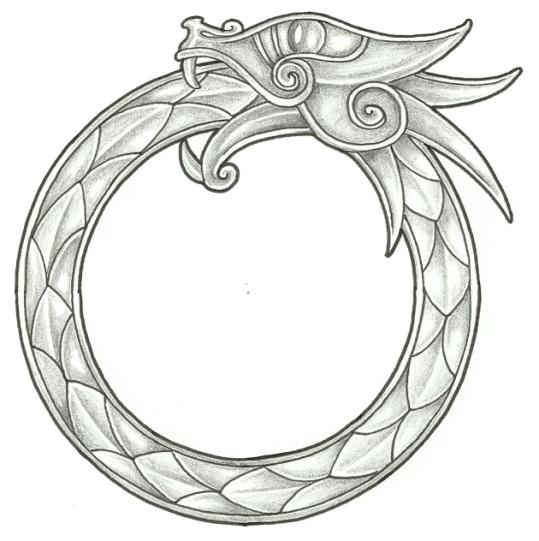
There is a serpentine sea-monster in the mythology of just about every ancient culture. In Norse Mythology, it's Jormungandr, the serpent who rings the world, and eats his own tail. In Egyptian and Greek Mythology, it's Ouroboros. In Mayan mythology, it's Quetzalcoatl. Notice the similarity between this and last weeks image of Behemoth, Leviathan, and Ziz from the Ambrosian Bible.
There's another mythological strand that connects even more closely to the Biblical Leviathan. In Egyptian mythology, the monster Apep is the embodiment of Chaos. Each day, Apep lies in wait just below the horizon and swallows the sun god, the bringer of light. Light is associated with order, and darkness with chaos. There's also a Native American legend about a snake swallowing the sun. At some point in his development, Leviathan takes on similar characteristics. Listen to Job's words in chapter three. This is the very first of Job's speeches after he loses everything:
Let the day perish in which I was born, and the night that said, A man-child is conceived. Let that day be darkness! May God above not seek it, or light shine on it. Let gloom and deep darkness claim it. Let clouds settle upon it; let the blackness of the day terrify it. That night—let thick darkness seize it! Let it not rejoice among the days of the year; let it not come into the number of the months. Yes, let that night be barren; let no joyful cry be heard in it.
And then, remarkably, Job invokes Leviathan, saying:
Let those curse it who curse the Sea, those who are skilled to rouse up Leviathan. Let the stars of its dawn be dark; let it hope for light, but have none; may it not see the eyelids of the morning—because it did not shut the doors of my mother’s womb, and hide trouble from my eyes.
So Job (not God!) is the one who first asks for Leviathan to be roused, to come forth and swallow the light, plunging the world (and Job) into complete darkness and chaos.
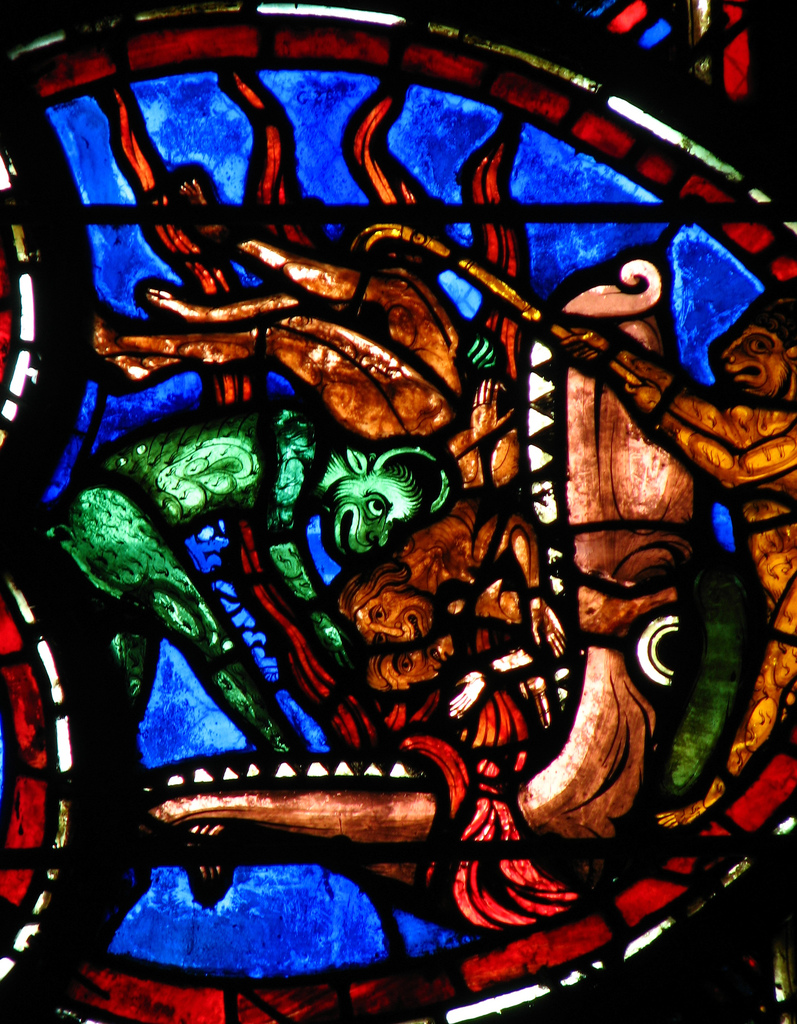
Fast forward to Anglo-Saxon England during the medieval period, where the giant fanged mouth of Leviathan, described in Job 40, gets mixed together with the Norse legend of Fenrir, also a god of Chaos who, incidentally, also swallows the sun (1908 drawing by W.G. Collingwood). Fenrir morphs into Leviathan to become "Hellmouth," his jaws depicted as the very gates of hell. (Winchester Psalter of about 1150). Images of Hellmouth become popular throughout Medieval Europe (Bourges Cathedral, ca. 12th century) and right down to our own day (Sarlacc from Return of the Jedi)
John Calvin and other 16th century reformers speculated that Leviathan was a whale. Herman Melville, in his classic novel Moby Dick, unsurprisingly does the same. Thomas Hobbes named his famous book about civil government "Leviathan," and the original book cover quotes Job 41:24. Other modern interpreters (including the footnotes to the NRSV) have concluded that Leviathan must be a crocodile, generally on the basis of the verses in Job that describe the creature's scaly back. Young earth creationists (as they do with Behemoth) point to the dinosaur. Of course, neither crocodiles, nor whales, nor dinosaurs (or any actual creature) are known to breathe fire, so all attempts to classify Leviathan are somewhat problematic. In fact, I think it's quite intentional that Leviathan defies classification. Isn't that the point of the poem--that Leviathan cannot be captured or comprehended? What is classification, if not just a 20th century way of capturing something?
My favorite take on Leviathan, however, comes from the Jewish Talmud (Avodah Zarah 3b), which teaches that God follows a strict daily routine:
- For the first three hours of every day, God studies the Torah.
- For the next three hours, he judges the world, and gets pretty frustrated.
- For the next three hours, he feeds and sustains all of creation (also hard work)
- So for the final three hours of each day, God plays with Leviathan in order to unwind.
I love this idea of God and Leviathan frolicking together in the sea--the Creator and his pet, both taking great joy from each other's companionship.
I love this idea, because I have a dog. Her name is Genevieve Ilana Locke, and she is (in my opinion) the best dog in the world. She is a strikingly beautiful purebred Bluetick Coonhound. To me she is a source of great comfort and joy (and occasional annoyance). She's a medium sized dog--big enough to jump a fence, but small enough to pick up, or to curl up in your lap. But if you happen to be a squirrel, or a cat, or (God forbid) a raccoon... then to you she would seem like a terrible, ferocious, destructive, and even deadly monster.
So she can be delightful...or she can be frightening, depending on your perspective. Both of those things can be true simultaneously, and I suspect the same is true of Leviathan. The same is true of chaos, and the powerful but destructive forces of nature--things like hurricanes, volcanoes and earthquakes (things which insurance companies used to call "Acts of God"). If you are the victim of those forces (like Job was), they are monstrosities. But in the grand scheme of God's creation, they also have a function, they serve a purpose, they are part of a rhythm, a routine, and a process by which mountains are formed, ecosystems are replenished, and energy is rebalanced for the benefit of the planet and all its inhabitants.
Of course, that perspective on Leviathan, while it is my particular favorite, would not have been very comforting to Job in the aftermath of his losses.
There's one more perspective on Leviathan which I think is hinted at in the Book of Job, and it connects with the perspective I shared last week on the other monster at the end of the book, Behemoth. I told you that I think Behemoth represents Job (and by extension, all of us). Behemoth is God's way of saying, look at this mighty creature--you are strong, just like him. You have what it takes to get through this.
Leviathan, in this perspective, is a bit different. Allow me to explain (but see if you can figure it out before I get to the end!).
At the very beginning of Job's long speeches that span most of the book, he demands that Leviathan be summoned. Later, he demands that God appear before him as well. At the end of the book, both God and (through his words) Leviathan show up. God's speech to Job has two movements. In the first, God speaks of creation--the earth, the sea, the snow, the rain--and then he goes on to describe several lesser animals--the lion, the mountain goat, the donkey, the ox, the ostrich, the horse, the hawk. If we were going to include whales, elephants, crocodiles and hippos, I would think this would be where they might fit best.
But in the second movement of God's speech, he describes the foremost wonder of his creation, the strong and mighty Behemoth--a mirror and symbolic representation of Job.
Then in that same section, we come to the climax, the most magnificent monster of all. All expectations of him fail; one falls at the eye-sight of him. At his rising the angels fear; they falter at his crash. He is unrivaled on the earth--without any fear is he formed. He beholds all those who are lofty-born; of the proud he alone is Lord.
Have you figured out who Leviathan is yet? One more clue. Job has asked for Leviathan to be roused, and God says, A cruel one, indeed, I roused him up. Who cares to contend with me? Note that God doesn't say, "I roused him up. who cares to contend with him?" He says, I roused him up...who cares to contend with me? If Behemoth represents Job, then I think Leviathan, here, represents God himself. Often in the Bible, God is associated with the highest heights. But occasionally it goes the other way. Romans 11:33 - O how deep are God's riches, and wisdom, and knowledge! How unfathomable are his decisions and unexplainable are his ways! Leviathan brings the deep to a cauldron boil and makes the deep look white-haired (the classic representation of God as "ancient of days").
When Job invokes Leviathan earlier in the book, he says, "Let the stars of its dawn be dark; let it hope for light, but have none; may it not see the eyelids of the morning." God, through Leviathan, is responding directly to Job's request when he says, "He sneezes and light bursts brightly forth; He blinks as the break of dawn." In other words, "You summoned me, Job. You summoned Leviathan to snuff out your light and plunge you into darkness. But Leviathan doesn't work that way. He brings light instead. I'm bringing you back into the light."
The monsters at the end of the book are the same ones each of us will encounter at the end of our own story--the ones Michelangelo so masterfully depicted on the ceiling of the Sistine chapel. One of those monsters is truly terrifying--and the other one is us.
When I come home at the end of the day, Genevieve, my Bluetick Coonhound, is without fail, every single time, completely overjoyed to see me. (I realize I'm totally messing up the metaphor here, but bear with me!).
Sometimes, her joy at seeing me is tempered with a little bit of well-placed fear--like when she knows that she has gotten into the kitchen trash can and spread out all of the trash across the kitchen floor. She knows there will be a reckoning--and usually she puts herself in her kennel immediately after I discover the mess. But she also knows that no matter what she's done, no matter how rough her day was, or how hard the reckoning--she knows that without fail, every single time, she will end her day curled up in my lap, drifting off to sleep, completely forgiven, completely and totally loved.
That's not a bad ending for a little monster, and for the big monster who loves her.
So it is with God, with those who love him, and those whom he loves. That's Leviathan. That's Job. That's me. That's you.